Tucson Pest Pros offers professional bee removal and wasp removal services as your local bee and wasp exterminator for the Tucson metropolitan area. We know how frustrating those buzzing insects around your home and business are. Whether you need immediate bee removal, are dealing with aggressive wasps, or require emergency bee removal for a swarm that just showed up, you’ve come to the right place. We are your local experts specializing in safely removing honeybees and their more aggressive cousins, the Africanized honey bees.
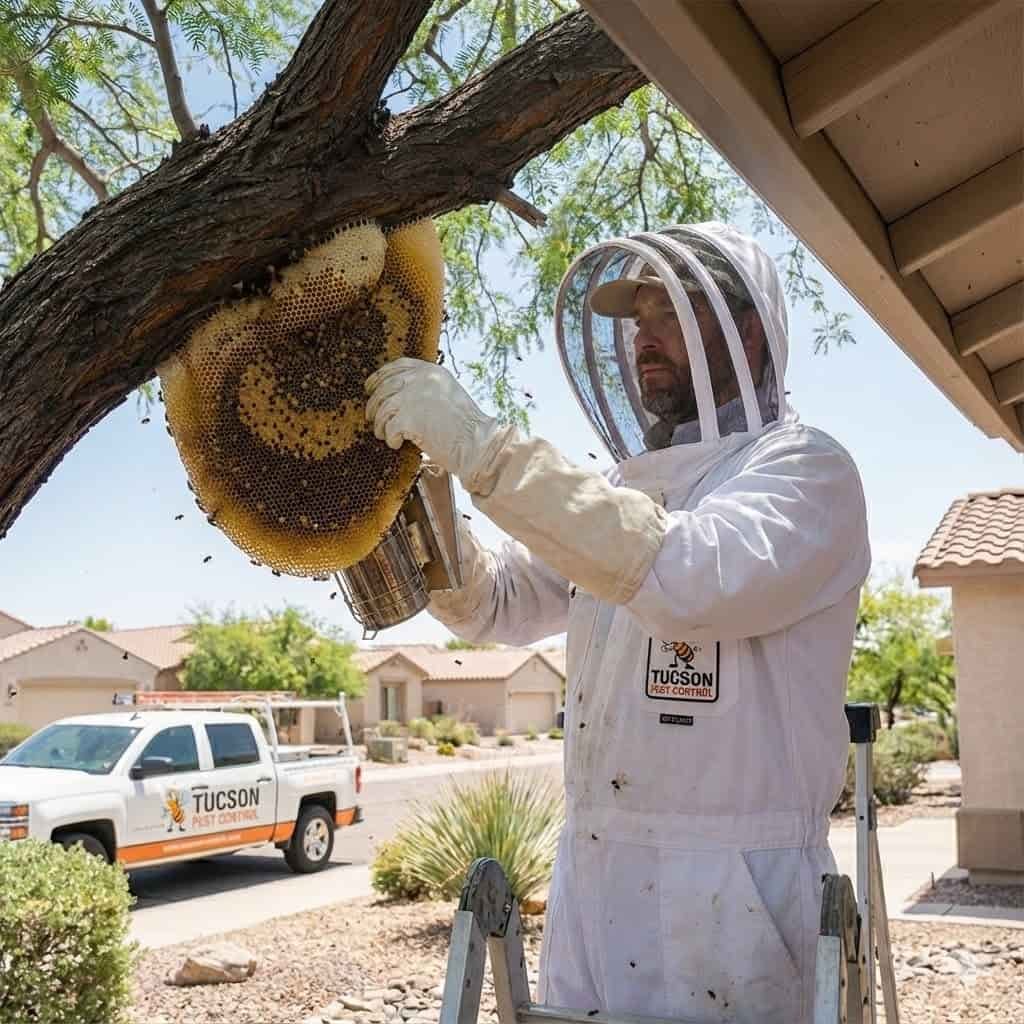
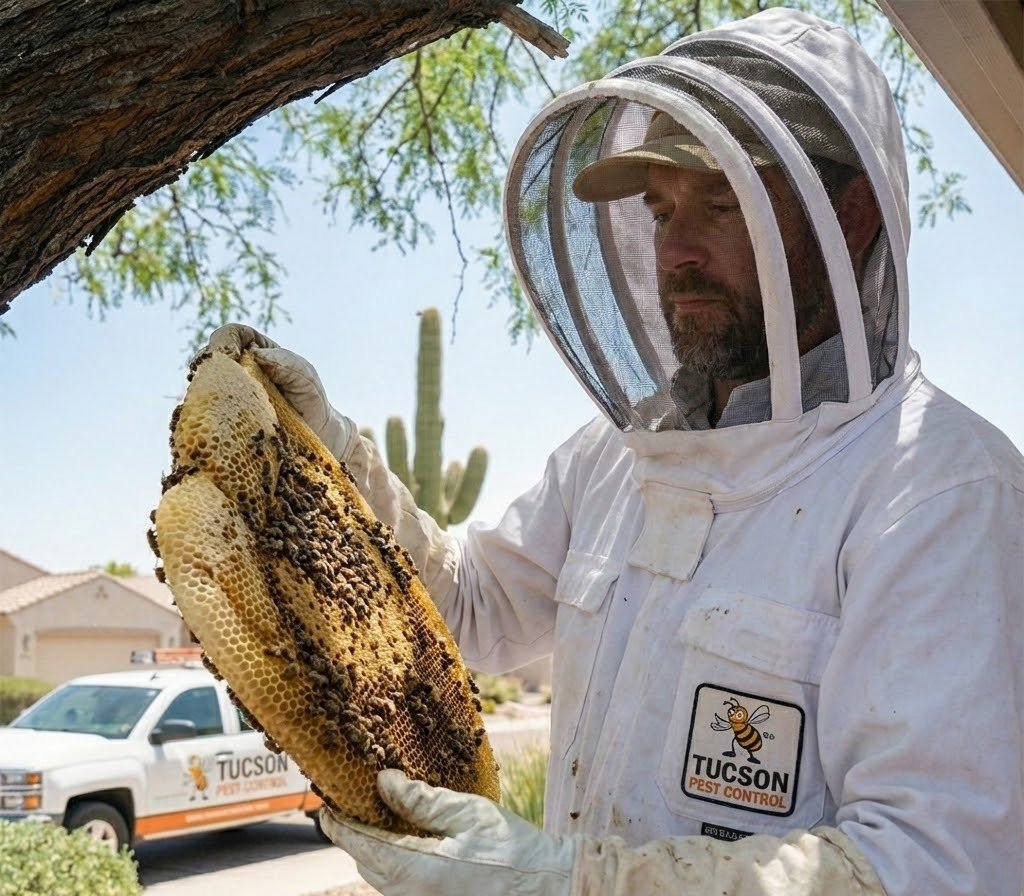
Bee infestations in Tucson are a serious problem due to the defensive behavior of local feral bee populations. According to the University of Arizona’s Department of Entomology, the feral honeybees in Southern Arizona are predominantly Africanized. This genetic lineage results in highly defensive, aggressive behavior, increasing the risk of stinging incidents. The primary threat is the bees’ tendency to pursue perceived threats, which can lead to multiple stings and endanger public/pet/family safety. An unmanaged hive also causes structural damage as the comb, honey, and brood expand, compromising building materials.
Awards
Tucson Pest Control is the best pest control service in Tucson. We have been consistently winning awards that showcase our expertise.







Services
Tucson Pest Control offers a full range of bee and wasp exterminator services to handle any bee or wasp problem you have. Our goal is complete control and trapping to ensure the issue is gone. This includes expert nest elimination, safe live bee relocation, and preventative bee/wasp-proofing to keep them from coming back.
Our live bee relocation service includes removing a colony of honeybees without exterminating them. This service is for European honeybees and feral honeybees of African lineage. Our state-certified experts will carefully remove the bee colony, including its comb, and relocate it to a place where it can thrive without bothering you.
We perform wasp nest removal through direct application of EPA-approved materials to the nest. Our experts use pyrethrum-based products against species such as yellow paper wasps, triggering immediate knockdown. A residual insecticide is then applied to the nest structure to eliminate the nest and prevent re-establishment of foraging wasps.
Honeycomb removal and repair is necessary to prevent secondary infestations and structural damage. The comb-removal process removes the remaining honey and wax. Untreated honeycomb can ferment and melt, seeping through drywall and wood and leading to rot and attracting ants, moths, and beetles. This cleanup prevents re-infestation and is often followed by minor structural repair to close the entry point.
We offer emergency bee removal for the immediate dispatch of transient bee swarms that pose a public threat. A bee swarm is a cluster of bees, including a queen and 5,000–10,000 workers, that has temporarily landed on an object. Our rapid-response team offers same-day service when available to collect or eliminate these swarms before they establish a permanent nest.
Service Area
We provide bee and wasp removal throughout the greater Tucson metro area, including:
| Tucson | 85701, 85705, 85710, 85711, 85712, 85714, 85715, 85716, 85718, 85742, 85747, 85749 |
| Oro valley | 85704, 85737, 85742, 85755 |
| Marana | 85653, 85658, 85743 |
| Sahurita | 85629 |
| Green valley | 85614, 85622 |
| Chandler | 85224, 85225, 85226, 85244, 85246, 85248, 85249, and 85286 |
Don’t see your neighborhood listed?
Commercial bee removal services are designed for non-residential clients. We provide solutions for businesses like restaurants and hotels, HOAs, property management companies, apartment complexes, large utility companies, construction companies, and mining sites. Services include installing a commercial swarm-trap system, conducting routine bee-trapping maintenance programs, and conducting property surveys for field crews and emergency personnel. We also work with realtors/buyers/sellers, and home watch groups.
Process
We keep things simple. Our bee-removal process has 3 steps:
We identify the bee species, locate the nest, and evaluate environmental risks.
We use the best method for the situation, whether it's live removal/relocation, trapping, or extermination. Our experts use techniques that involve pheromone lures and pheromone scent to attract bees to a safe location. We always use non-toxic treatments whenever possible.
We clean the area and offer advice to keep bees away for good.
Tucson’s Africanized honeybee swarm season peaks in spring, roughly February through June, as colonies grow and split following the desert bloom — this is when scout bees and new swarms are most commonly spotted around homes. A smaller secondary swarm period can occur in early fall. Paper wasps, on the other hand, are typically most active and aggressive from late summer into fall (August–October), when colonies reach peak size and are actively foraging before winter die-off. If you’re noticing increased bee or wasp activity, it’s worth having your property inspected before a swarm settles into a wall void or roofline.
Our technicians are state-certified and operate under strict master technician procedures. Each technician completes over 60 hours of safety training on Africanized honey bees before field service. This training minimizes public safety risk during the removal process. Our performance is quantified by our ratings/reviews, which maintain a 4.9-star average across platforms.
We know Arizona's unique pest challenges inside and out.
Your family and pets' safety is our top priority.
If they come back, so do we. No charge.
No hidden fees or surprise charges. Ever.
Highly trained and background-checked professionals.
We work around your schedule to minimize disruption.
If you see an established hive or an active swarm, don’t attempt DIY removal — Southern Arizona’s feral bee population is predominantly Africanized and highly defensive, and disturbing a hive can trigger a mass-stinging response. For a few scout bees or a very small, newly-forming nest, some homeowners try soap-water spray, but this is not recommended once comb is visible or activity is heavy. Call a licensed pest control company for safe inspection, live relocation, or removal.
The average cost to remove bees and wasps ranges from $150 to $1,500. The exact price depends on the type of pest, the extent of the infestation, the location of the nest, and the complexity of the job.
The best time to remove bees and wasps is early morning or late evening, when the temperature drops and they are least active and most of them are inside their colonies.
All over! We find them in rooftops, parapet walls, scupper drains, vega beams, roof vents, and in the attic/roof space. They also love hollow walls, slump block ranch walls, backyard block perimeter walls, irrigation/valve boxes, under decking, and even inside saguaro cactus hollows or tree hollows. We’ve seen them in outdoor sheds, yards, mobile homes, on utility poles, cellphone towers, and inside outdoor light fixtures and electric panel boxes. If there’s a protected space, they might call it home.
Those are likely scout bees. Their job is to find a new home. This scout behavior is a key sign that a whole swarm might be on its way. If you observe aggressive bee behavior or see nests/hives visible via steady activity at a crack or crevice, it’s time to call.
No — Arizona does not have a state law protecting feral honeybees, including Africanized colonies, the way some states protect managed apiaries. Beekeeping itself was deregulated in Arizona in 1994, and there’s no statewide permit requirement to remove or destroy a feral hive on your own property. That said, we recommend live relocation whenever it’s safely possible: honeybees are important pollinators, relocation avoids leaving a large, decomposing honeycomb inside your walls, and it’s often no more expensive than extermination.
We don’t recommend it once a nest is established. Africanized honeybee colonies can contain thousands of highly defensive workers, and a disturbed hive can chase a person more than 100 yards. Wasp nests carry a similar risk of multiple-sting attacks, especially in late summer and fall when colonies are largest. DIY sprays often only agitate the colony rather than eliminate it, and working at height (rooflines, eaves) adds a fall risk on top of the sting risk. Professional removal uses proper protective equipment and the right treatment for the specific species.
Yes, especially with Africanized honeybees, which are known to react more aggressively and in larger numbers than European honeybees. Multiple stings can be dangerous for small children, pets, and anyone with an allergy. We recommend keeping people and animals away from any active hive or nest and calling for removal rather than attempting to manage it yourself.
Public-safety swarm calls are prioritized for same-day dispatch when available. Call +15204626999 and let us know it’s an active swarm so we can route it accordingly.
Don’t wait for the problem to get bigger. Our emergency response team is ready to help. We offer services for everyone, from realtors/buyers/sellers needing an inspection to city and county managers and emergency personnel dealing with a public safety issue. For long-term protection, ask about our bee-trapping maintenance programs and our residential scout-trap system. We even offer specialized services, such as non-toxic water-feature perimeter treatments.