
You noticed something strange in your home. Maybe a pile of tiny pellets near a baseboard. Maybe paint is bubbling for no reason. You are not sure if it is termites, but something feels wrong.
That uncertainty is stressful. Termites cause over $5 billion in property damage across the United States every year. Most homeowners do not find out until the damage is already serious. This guide covers every sign of termites in plain language, tells you exactly where to look, and explains what to do the moment you find something suspicious and how termite exterminators can help you.

Why Termites Are Easy to Miss (And Expensive to Ignore)
Termites are hard to detect because they live and feed completely out of sight. They tunnel through wooden beams, floor joists, and wall studs while leaving the outer surface intact. A wall can look perfectly fine while termites hollow it out from the inside.
Unlike pests like ants, cockroaches, and silverfish, termites never come out in the open. Worker termites avoid light and open air at all times. Most infestations run 3 to 8 years before a homeowner notices anything wrong.
The financial damage is significant. The average termite repair bill runs between $3,000 and $8,000. That number rises sharply when structural elements like support beams and floor joists need full replacement. Standard homeowners insurance policies classify termite damage as a preventable maintenance issue and do not cover it.
Tucson and Southern Arizona face higher risk than most regions. The area hosts aggressive species like arid-land subterranean termites and western drywood termites. Dry heat pushes termites deeper into structures in search of moisture. Monsoon rains then trigger swarming and intense colony activity. Termite pressure here runs year-round, not just in one season.
Catching signs early is the difference between a treatment bill and a reconstruction bill.
What Termites Actually Look Like
Most people have never seen a termite up close. Knowing what each type looks like helps you identify an infestation before it becomes serious.
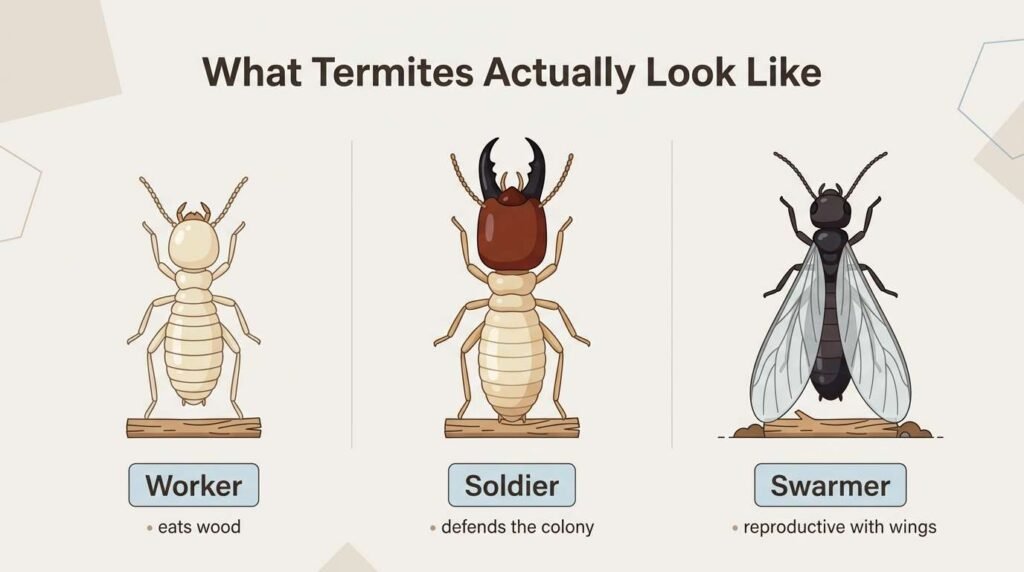
Workers and Soldiers
Worker termites are small, pale insects that stay hidden inside wood and soil at all times.
- Size: About 1/8 of an inch long
- Color: Creamy white to pale yellow
- Head: Rounded, no visible mandibles
- Wings: None
Soldier termites share the same pale body but are built differently.
- Head: Larger, darker, rectangular
- Mandibles: Prominent, used to defend the colony
- Behavior: Stationary defenders, not foragers
Both castes die within minutes when exposed to air and light. Spotting either one means you have broken into an active tunnel or disturbed a live feeding site.
Swarmers (Flying Termites)
Swarmers are the only termites you are likely to see out in the open.
- Size: 1/4 to 3/8 of an inch long
- Color: Dark brown to black
- Wings: Two pairs of equal length
- Antennae: Straight
Flying ants are the most common look-alike. Flying ants have unequal wings, bent antennae, and a pinched waist. Termite swarmers have none of those features.
In Tucson, swarmers appear between March and June, with a second wave after monsoon rains in July. Swarmers found indoors are a more urgent signal than those found outside. An indoor swarm means a mature colony of at least 3 to 5 years old is already active inside or beneath your home.
The Most Common Signs of Termites in a House
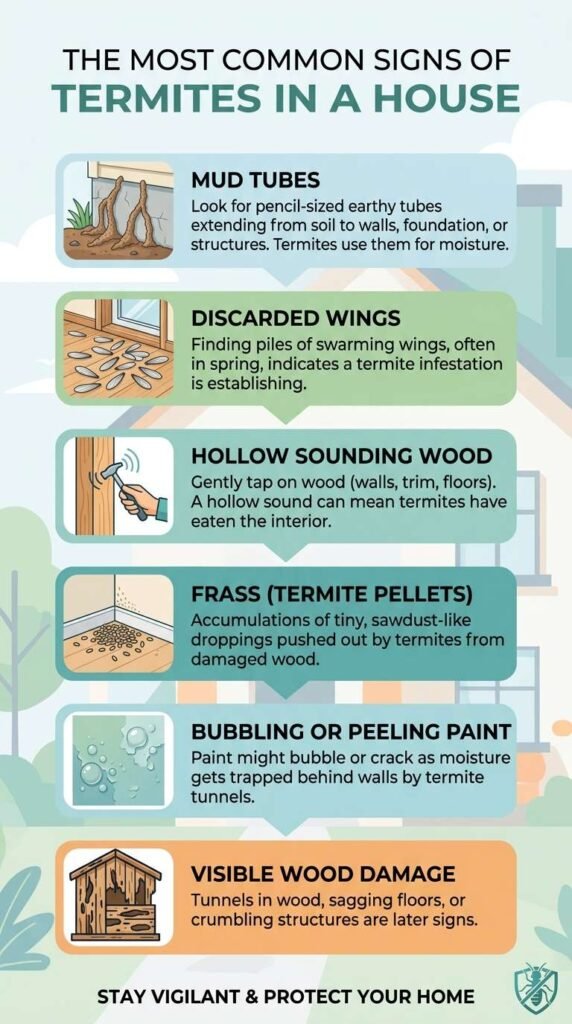
Mud Tubes
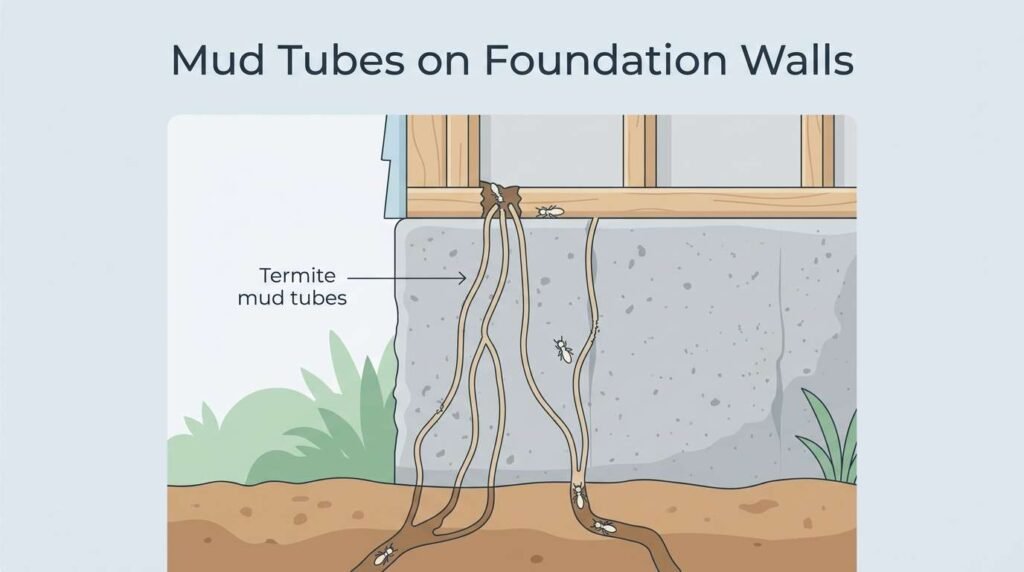
Mud tubes are pencil-thin tunnels made of soil, wood particles, and termite saliva, used by subterranean termites to travel between the ground and your home.
They appear on:
- Foundation walls
- Concrete slabs
- Crawl space piers
- Exposed wood near the ground
In Tucson stucco homes, termites also enter through weep holes, expansion joints, and foam insulation gaps. These entry points rarely produce visible mud tubes, which is why professional inspection matters even when no tubes are found.
To test activity, break off a small section of tube. If termites repair it within a few days, the colony is live. If it stays broken and dry, the infestation may be old or inactive. Do not destroy the entire tube before an inspection. Pest professionals use it to trace the colony’s entry point.
Discarded Wings
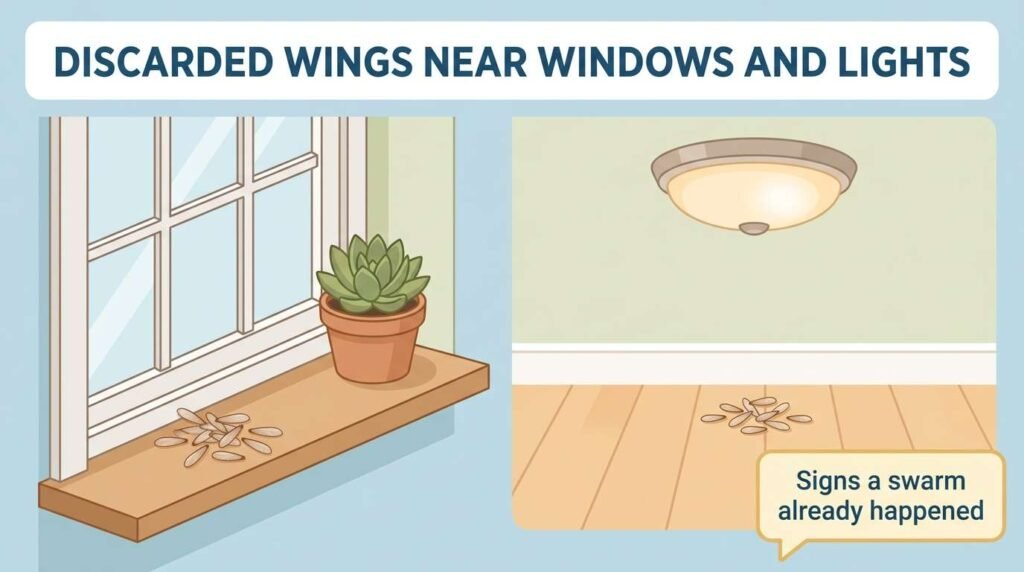
Discarded wings are one of the earliest and most reliable signs of a termite infestation.
After swarmers mate, they shed their wings immediately. Small piles typically appear near:
- Windowsills
- Door frames
- Light fixtures
- Basement floors
All wings are the same size and shape, which separates them from ant wings. Finding wings indoors confirms a swarm already occurred inside your home. That points directly to a mature, active colony nearby.
Hollow-Sounding Wood
Wood that sounds hollow when tapped is a strong indicator that termites have been feeding inside it.
Knock firmly on baseboards, wall panels, door frames, and floorboards using your knuckle or a screwdriver handle. Solid wood produces a dense, dull thud. Termite-damaged wood produces a hollow, papery echo.
Pay close attention to areas near the floor, behind walls, and under stairs. Subterranean termites reach these spots first after entering through the foundation.
Frass (Termite Droppings)
Frass is the fecal matter left behind by drywood termites, and it looks like tiny pellets of sand or coffee grounds.
Each pellet is about 1 millimeter long, six-sided, and wood-colored, ranging from light beige to dark brown. Frass collects in small piles directly below kick-out holes, which are tiny openings drywood termites use to push waste out of their tunnels.
Clean up a pile and check back in 24 to 48 hours. If it reappears, the colony is active. Sawdust from cutting or drilling is irregular in shape and does not return after cleanup.
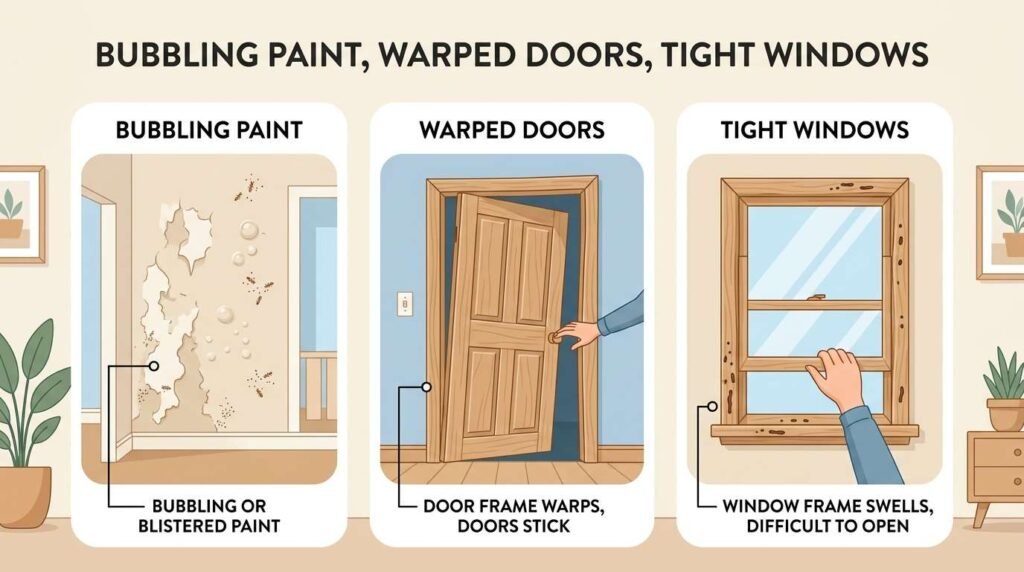
Bubbling Paint, Warped Doors, and Tight Windows
Bubbling paint, doors that stick, and windows that no longer open smoothly can all signal termite activity behind the surface.
Termites introduce moisture into wood as they tunnel through it. That moisture causes wood to swell, warp, and expand. Paint over termite-damaged areas bubbles, cracks, or peels with no water source nearby.
Humidity produces similar symptoms, but the pattern differs. Humidity affects large surface areas evenly. Termite damage appears in isolated spots near floor level, door frames, or windowsills. One sticking door or one bubbling paint patch with no plumbing nearby is worth investigating.
Visible Wood Damage
Visible wood damage means a termite infestation has been active for a long time, typically 3 to 5 years or more.
Signs include:
- Wood that crumbles when pressed with a screwdriver
- Blistered or sunken areas on wood surfaces
- Parallel grooves running inside exposed wood
- Beams and joists that look intact but collapse under pressure
At this stage, the damage goes beyond cosmetic repair. A structural inspection by a licensed contractor is recommended alongside pest treatment.
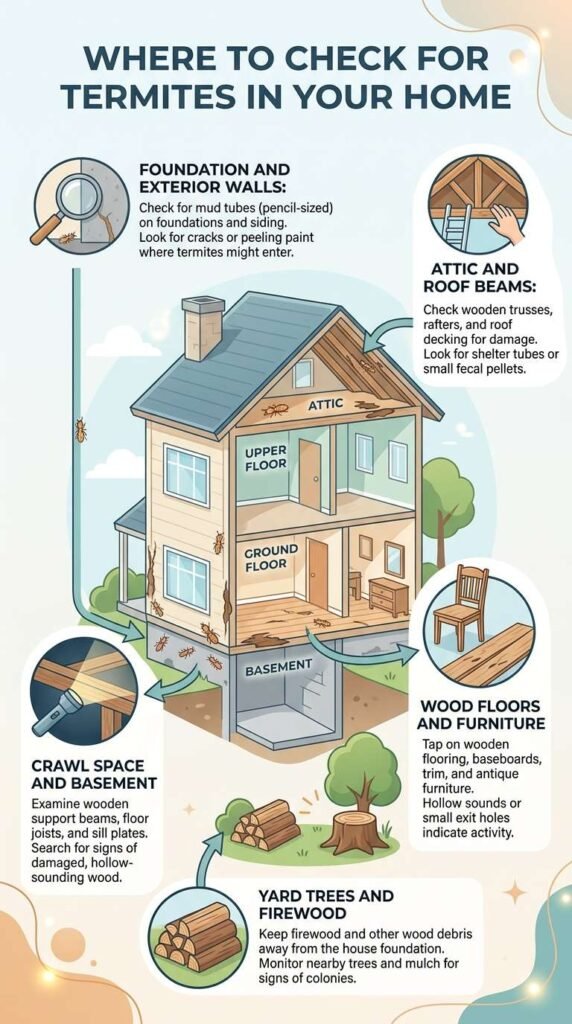
Where to Check for Termites in Your Home
The most important places to check for termites are areas where wood meets soil, moisture collects, or ventilation is poor.
Start from the outside and work inward.
| Location | What to Look For |
| Foundation and exterior walls | Mud tubes on concrete or brick, wood touching soil, cracks near utility lines |
| Crawl space and basement | Mud tubes on piers and joists, soft or hollow wood when probed |
| Attic and roof beams | Frass piles on attic floor, kick-out holes in beams, blistered wood |
| Wood floors, furniture, drywall | Hollow floor sections, frass near furniture joints, mud spots on drywall |
| Yard, trees, and firewood | Mud tubes at tree bases, hollowed fence posts, firewood stored against the house |
Keep firewood stacked at least 20 feet from the home and elevated at least 6 inches off the ground. Firewood stored against the exterior wall is one of the most common termite entry points in Southern Arizona.
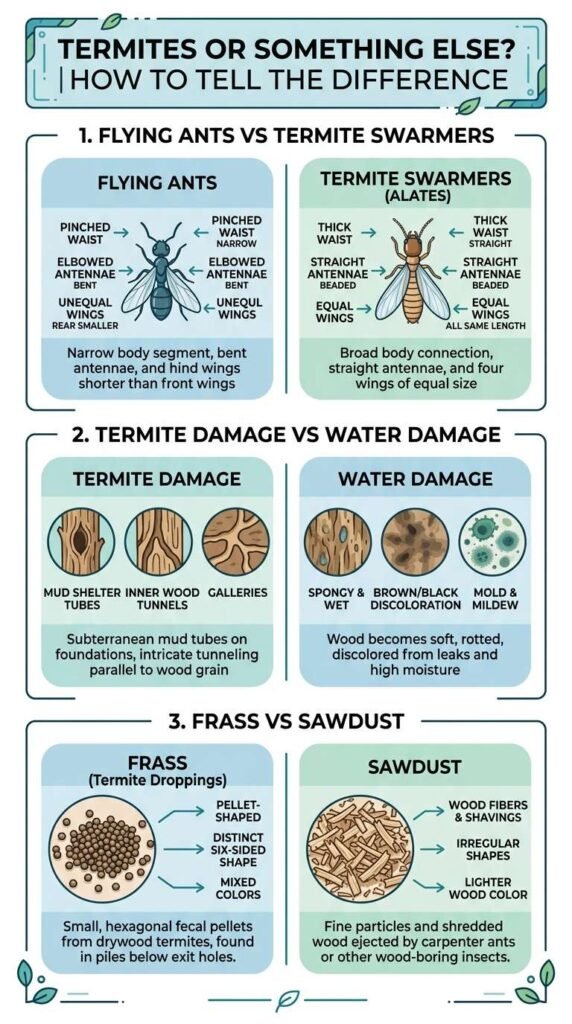
Termites or Something Else? How to Tell the Difference
Termites are frequently mistaken for other insects and types of damage, which leads homeowners to ignore early warning signs or treat the wrong problem.
Flying Ants vs. Termite Swarmers
The fastest way to tell a termite swarmer from a flying ant is to look at the wings and waist.
| Feature | Termite Swarmer | Flying Ant |
| Wings | Equal length, all 4 | Unequal, front longer |
| Waist | Thick, no pinch | Narrow, pinched |
| Antennae | Straight | Bent at 90 degrees |
| Body color | Dark brown to black | Black, red, or brown |
Termite swarmers in Tucson appear most heavily in spring and after monsoon rains. Flying ants are more common in summer. If you find insects near a window or light after rain, check the waist and antennae before drawing any conclusions.
Termite Damage vs. Water Damage
Termite damage and water damage look similar on the surface but have clear differences on closer inspection.
Water damage softens, darkens, and rots wood uniformly across an affected area. Termite damage hollows wood from the inside while leaving the outer surface intact. Press a screwdriver into the area. Water-damaged wood feels spongy and wet. Termite-damaged wood feels hollow and dry, and may collapse inward.
Two further differences:
- Water damage traces back to a moisture source like a pipe, roof, or window seal. Termite damage has no obvious water source nearby.
- Termite-damaged wood contains galleries, which are thin parallel tunnels packed with soil or mud. Water-damaged wood has none.
Frass vs. Sawdust
Frass and sawdust look similar at a glance but are easy to separate once you know what to look for.
| Feature | Frass | Sawdust |
| Shape | Uniform, six-sided pellets | Irregular, varied shapes |
| Size | About 1mm each | Varies widely |
| Color | Beige to dark brown | Usually pale yellow or white |
| Texture | Grainy, like coarse sand | Fine to coarse, fluffy |
| Location | Neat piles below kick-out holes | Scattered near cutting or drilling |
Sawdust does not return after cleanup. Frass reappears within 24 to 48 hours if the colony is active. That reappearance test confirms drywood termite activity without opening any walls.
Signs of Termites Specific to Tucson and Southern Arizona
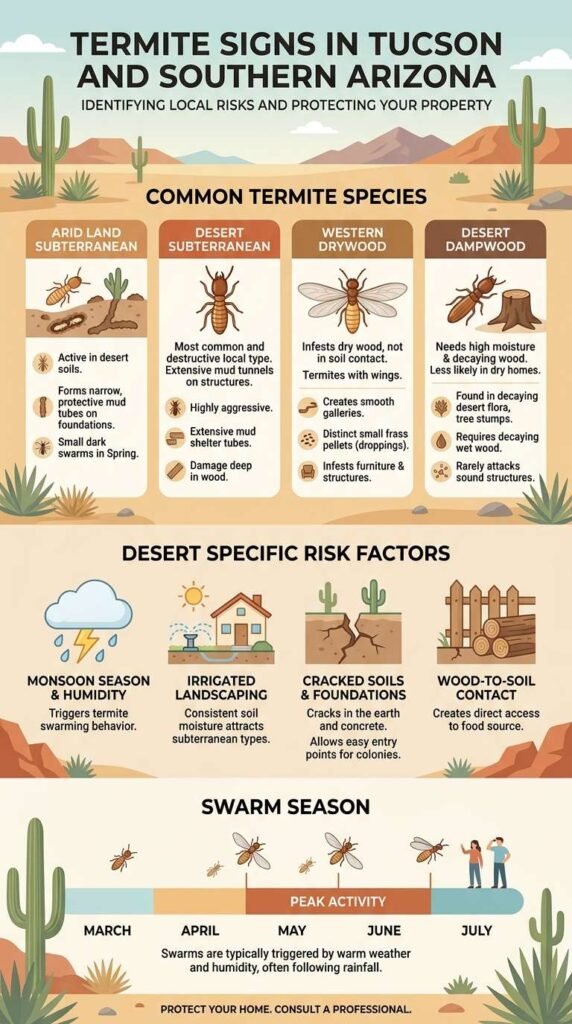
Tucson and Southern Arizona have some of the highest termite pressure in the United States, driven by heat, seasonal moisture, and multiple active species.
Common Termite Species in the Tucson Area
| Species | Key Sign | Risk Level |
| Arid-land subterranean | Mud tubes near the foundation | Very high |
| Desert subterranean | Mud tubes, less moisture needed | High |
| Western drywood | Frass pellets, no mud tubes | High |
| Desert dampwood | Soft wood near moisture sources | Moderate |
Desert-Specific Risk Factors
| Risk Factor | Why It Matters |
| Irrigation systems near foundation | Keeps soil moist, attracts subterranean termites year-round |
| Stucco exteriors with weep holes | Termites enter through gaps without producing visible mud tubes |
| Wood-to-soil contact | Gives termites direct access with no mud tube required |
| Flat roofs and poor drainage | Traps moisture after rain, encourages drywood termites in roof beams |
| Post-monsoon soil moisture | Triggers swarming between March and July |
Swarm season in Tucson runs from March through June, with a second spike after the first monsoon rains in July. Swarms last 30 to 40 minutes. Most homeowners only notice the discarded wings left behind near windows and light fixtures.
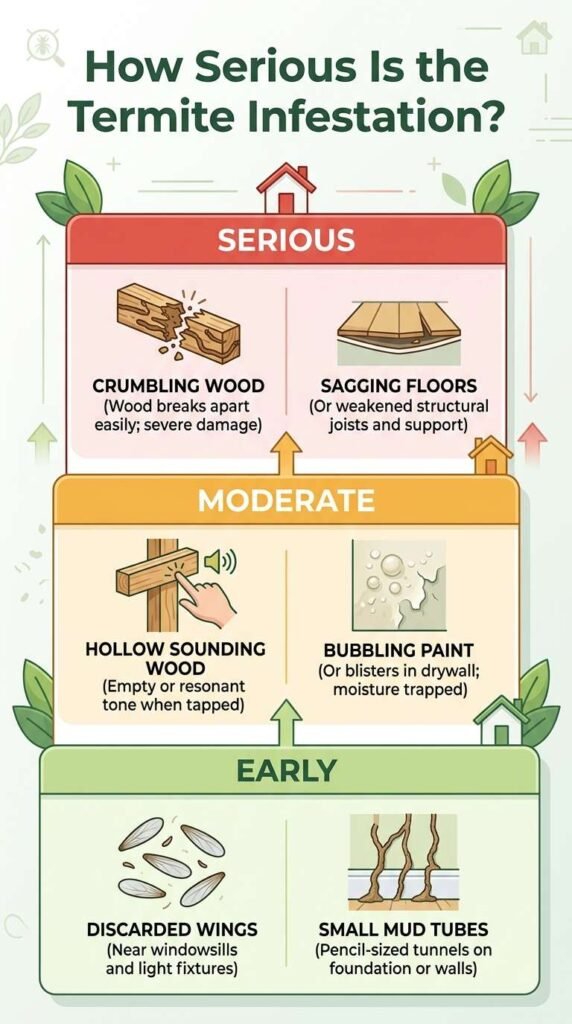
How Serious Is the Infestation? Early Signs vs. Structural Damage
The severity of a termite infestation is determined by which signs are visible and how far the damage has spread.
| Stage | What You See |
| Early | Discarded wings, small frass piles, one or two mud tubes |
| Moderate | Hollow-sounding wood, bubbling paint, sticking doors or windows |
| Serious | Crumbling wood, sagging floors, collapsing drywall, multiple mud tubes |
Early signs mean the colony is present but structural damage is still limited. Moderate signs suggest active feeding for at least 1 to 2 years. Serious signs require both pest treatment and a licensed contractor for structural repair.
Call a professional without delay if you find:
- Sagging or bouncy floors
- Cracks in load-bearing walls
- Wood that collapses when pressed with a screwdriver
- Swarmers emerging from inside the walls
What to Do When You Find Signs of Termites
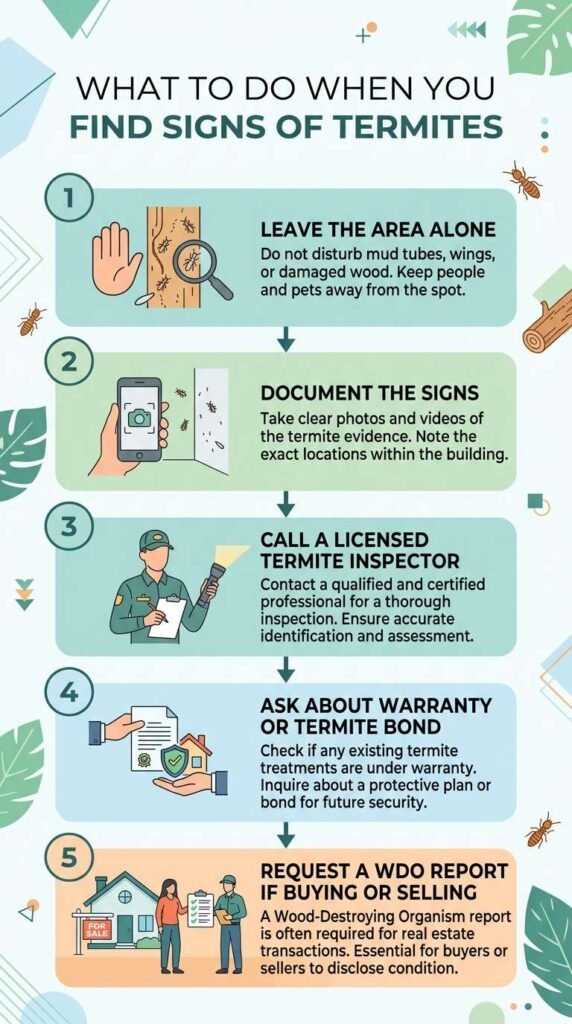
The first thing to do when you find signs of termites is stop and leave the affected area completely alone.
Spraying household pesticides like Raid or bug bombs scatters the colony deeper into the structure. That makes it significantly harder for professionals to locate the source and apply targeted treatment.
Follow these steps instead:
- Leave the area undisturbed. Do not spray, seal, or scrape anything you find.
- Document what you found. Photograph mud tubes, frass piles, damaged wood, or discarded wings. Record the exact location and date.
- Call a licensed termite inspector. In Arizona, inspectors must be licensed through the Office of Pest Management. A standard inspection takes 1 to 2 hours and covers the foundation, crawl space, attic, and interior walls. Inspection costs typically range from $75 to $150 for a standard residential property.
After treatment, ask about a termite bond, which is a service warranty that covers retreatment or repairs if termites return within a specified period. Many Tucson pest control companies offer bonds as part of their annual protection plans. Treatments typically involve systems like Sentricon bait stations or Termidor liquid termiticide, both of which target the colony rather than individual insects.
Questions to ask your inspector:
- Which species is responsible and where is the colony entering?
- Is the damage active or old?
- What treatment method do you recommend and why?
- How long does the treatment take to work?
- What does the warranty or termite bond cover?
If you are buying or selling a home in Tucson, request a Wood Destroying Organism (WDO) report from a licensed inspector. Most lenders require this report before closing, and it documents any active or past termite activity on the property.
How to Make Your Home Less Attractive to Termites
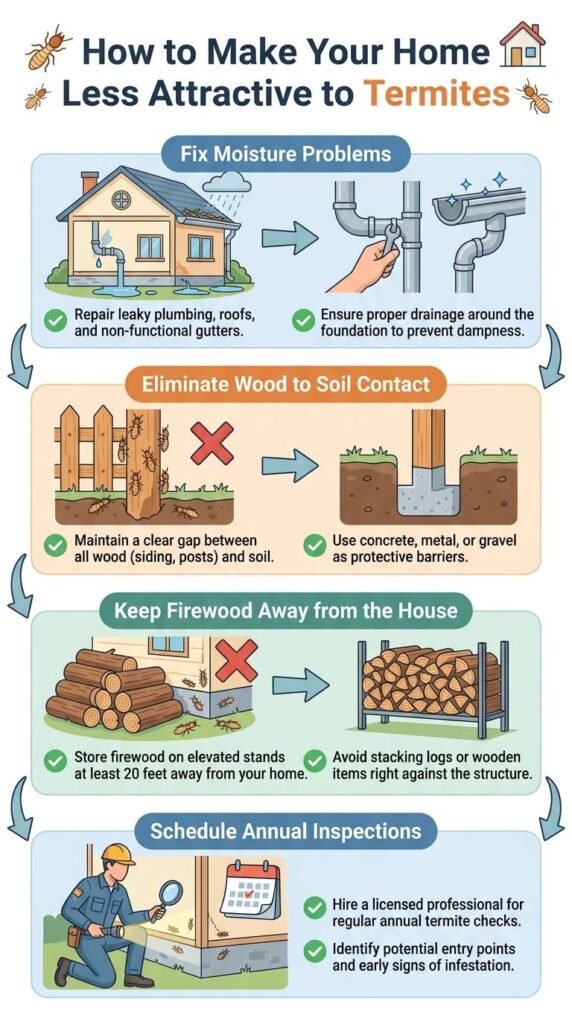
Termites need three things to establish in a structure: moisture, wood, and an entry point.
Removing any one of these reduces the risk significantly.
Fix moisture problems near the foundation: Subterranean termites follow moisture. Fix leaking pipes, redirect sprinkler heads at least 18 inches away from the foundation, and ensure gutters drain water away from the base of the home. In Tucson homes, AC condensation lines are a frequently overlooked moisture source. Check them every season.
Eliminate wood-to-soil contact: Any wood touching bare soil is a direct entry point. This includes fence posts, porch steps, door frames, and wood siding. Maintain a gap of at least 6 inches between soil and any wooden structure. Replace ground-contact wood with concrete, steel, or pressure-treated lumber where possible.
Keep firewood away from the house: Firewood stacks are one of the most common termite harborage points in Southern Arizona. Store firewood at least 20 feet from the home and elevated at least 6 inches off the ground on a metal rack.
Schedule annual inspections: The National Pest Management Association recommends annual termite inspections for all homes. In Arizona, where termite pressure runs year-round, skipping a year is a genuine risk. An annual inspection is the only reliable way to catch new activity before it reaches the structural stage.
Conclusion
In conclusion, termites are a silent and costly problem, especially in Tucson and Southern Arizona where multiple aggressive species remain active year-round. The most reliable signs include mud tubes along the foundation, discarded wings near windows, hollow-sounding wood, frass pellets, and bubbling or peeling paint. Drywood and subterranean termites leave different clues, and knowing the difference helps you act faster and smarter.
Catching these signs early is what separates a manageable treatment from a major structural repair. Know where to look, how to test what you find, and when to stop investigating on your own and call a professional.
If you have spotted any of these signs in or around your home, do not wait.
Call us today for professional termite inspection and control services in Tucson and Southern Arizona. Our licensed inspectors will identify the problem, trace the source, and recommend the right treatment to protect your home before the damage goes any further.
Frequently Asked Questions
What are the first signs of termites in a house?
The first signs of termites are usually discarded wings near windows, small mud tubes along the foundation, or tiny frass piles beneath wooden surfaces. These signs appear before any visible structural damage and indicate an active colony is already present.
How long can termites go undetected?
Termites can go undetected for 3 to 8 years in some cases. They feed inside wood and soil without breaking the outer surface. Schedule a professional inspection if your home has not been checked in the past 12 months.
What does termite damage look like?
Termite damage looks like hollowed, blistered, or grooved wood that crumbles when pressed. In drywall, it appears as sunken trails or bubbling paint without any nearby water source.
Can you have termites without seeing any bugs?
Yes. Workers and soldiers never come into the open, and swarmers appear for only 30 to 40 minutes during swarming events. Most homeowners confirm an infestation through physical signs rather than live sightings.
What is termite frass and is it dangerous?
Termite frass is the fecal matter produced by drywood termites. It appears as uniform, six-sided pellets roughly 1 millimeter in size. Frass is not dangerous to humans but confirms active drywood termite activity nearby.
What happens if I ignore termite signs?
Ignoring termite signs allows the colony to keep feeding and expanding inside your home’s structure. Repair costs rise sharply once damage reaches load-bearing elements like floor joists, wall studs, and support beams. Termite damage is not covered by standard homeowners insurance.
How do I know if my termite damage is active or old?
Break a small section of a mud tube and check if it is rebuilt within a few days. For frass, clean up the pile and check back in 24 to 48 hours. Old damage shows dried, empty galleries with no live insects present.
Are termites worse in Tucson than in other parts of the US?
Yes. Tucson and Southern Arizona rank among the highest-risk termite regions in the country. The area hosts species like arid-land subterranean termites and western drywood termites, with activity driven year-round by heat and seasonal monsoon moisture.
What is the difference between termites and flying ants?
Termite swarmers have straight antennae, a thick waist, and four wings of equal length. Flying ants have bent antennae, a pinched waist, and front wings longer than the rear pair. Check all three features before drawing a conclusion.
How much does termite treatment cost in Tucson?
Termite treatment in Tucson typically costs between $500 and $2,500 depending on the method, species, and infestation size. Structural repairs from untreated damage average between $3,000 and $8,000 and are billed separately from treatment.
Can I treat termites myself?
DIY surface sprays do not reach the colony and often push termites deeper into the structure. Licensed professionals use targeted systems like Sentricon bait stations and Termidor liquid termiticide that eliminate the colony at its source.
How often should I get a termite inspection in Arizona?
Every Arizona home should be inspected once a year at minimum. In high-pressure regions like Southern Arizona, annual inspections are the only reliable way to catch new activity before it reaches the structural stage.
What attracts termites to a house?
Termites are attracted to moisture, wood in contact with soil, and structural entry points like foundation cracks and utility penetrations. In Tucson, irrigation systems near the foundation and wood-to-soil contact are the two most common attractants.
Will termites go away on their own?
No. Termite colonies do not leave or die off without treatment. A colony keeps feeding as long as a food source is available. Book a professional inspection if you suspect activity, even if signs are minor.